YouTube, FTC, and Government Disconnect: Why Government Policies to Strengthen Privacy Needs Nuance to Prevent Irreversible Damage
The way YouTube would target kids is mainly through the way certain channels monetize. When content creators choose to monetize, YouTube runs personalized ads on that person's or organization's page. Then, sending personalized advertisements to those users. One of the biggest problems are channels that are made specifically to be viewed by children under the age of 13. If YouTube had personalized ads on those channels, that would target children specifically for revenue.
The FTC also ruled that YouTube would need to move towards a system that can tag, and maintain, content that is specifically child-directed. While there is praise for the FTC for making such large move against the tech-giant, the FTC's involvement may have consequences that aren't as optimistic as what law makers and law enforcers thought. With the newest draft of COPPA released in November, those that the FTC are punishing are not the platform but the content creators and content consumers.
COPPA Legislature
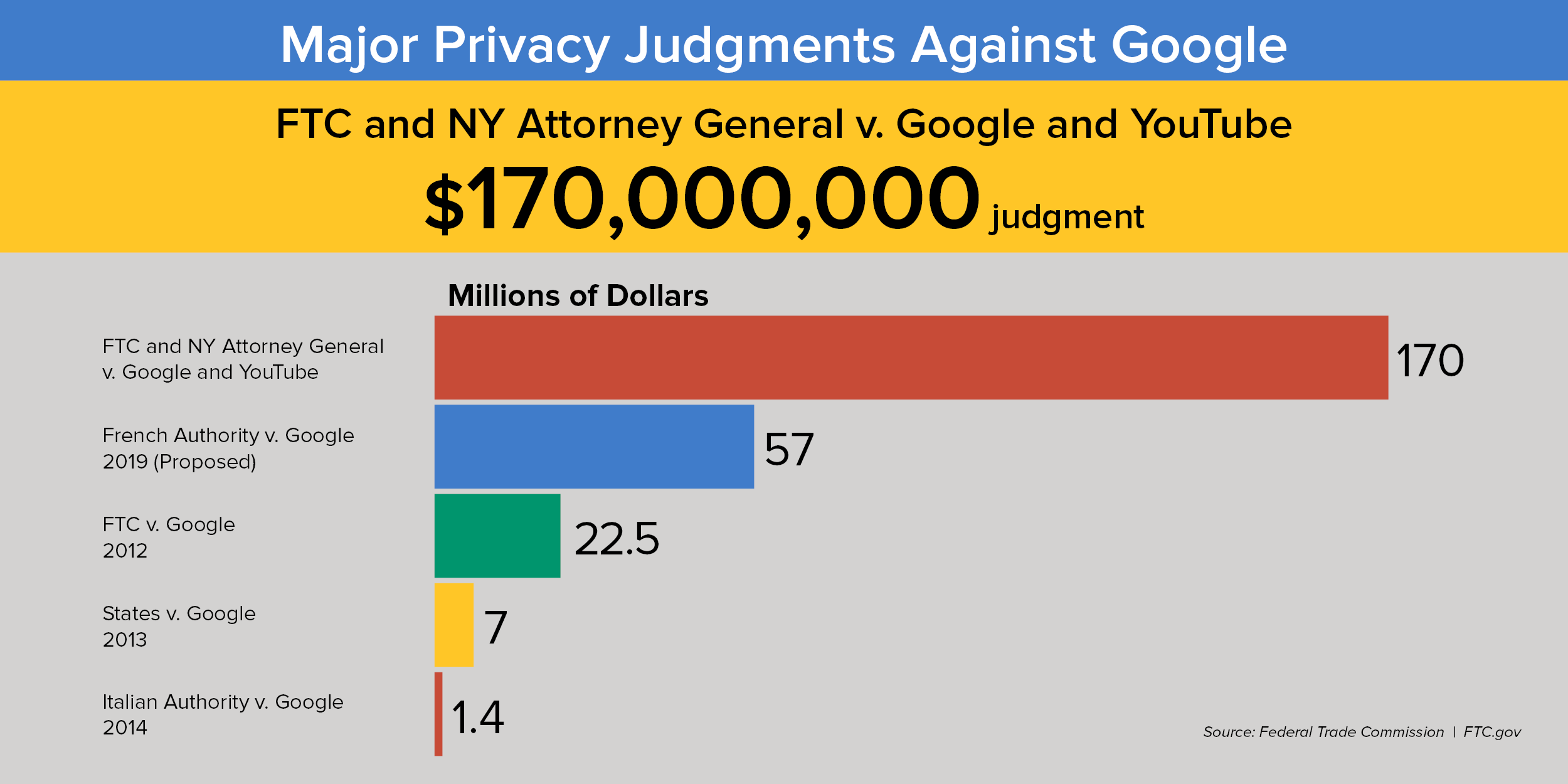
COPPA's previous wording was, honestly, laughable. The main issue with the writing was that children under the age of 13's data could not be tracked without the permission of the parent. That requirement is flimsy at best to ineffective at worst. How exactly, since the access to the internet in 2019 is so easy, would the FTC prove that a child is on a website? (Link to Chapter 91 - COPPA regulation) Furthermore, since any violation is a civil case, the compensation for damages would always be of monetary. While this section was written in 2012, most of compensation doesn't amount to that much since Google made a ridiculous amount of money. While $170 million is the most for a COPPA violation, Google made $40.3 billion in the third quarter of the year alone. So, previous version of COPPA have proven ineffective. What changes are possible?
With YouTube's violation, the site has to go under stricter revisions to the kind of content that's available. This has always been an issue for YouTube since the site has millions of videos uploaded every week. The FTC decided, as way to protect kids, rewrote YouTube's policy on content in the best way to protect children by removing targeted ads from all material deemed as "children's content." While targeted ads may be disastrous in the view of some privacy advocates, and this move would curb content away from advertisement-esque videos, the burden falls on the site users rather than YouTube.
What this move means?
When when the policy goes into effect, that would mean the removal of targeted ads on channels that summed into four categories: Aimed at children, animated or toys, an audience of children, or activities that children are interested in. Violations of the new targeted ad system will result in fines for individual users rather than YouTube. The major problem with this policy is the fact that children are diverse - children have many interests. Channels that aim at kids would be affected, but even those channels whose content and audience aren't children would have. Video game channels, for example, would be hit. Even if the channel has no intention of being for kids and the audience for that channel aren't kids. So, how much will this effect content creators?
In terms revenue, this change would destroy the feasibility of having a livelihood on YouTube. If channels fall under the four categories that would exempt channels from targeted ads, that would mean any income from those channels would come from outside of of targeted ads. By estimates made by Matthew Patrick (The Game Theorists channel on YouTube), targeted ads make form anywhere between 80-90% of a monetized channel's revenue. Cutting that amount would mean having other means to make a living, also a reduction in content that would have otherwise thrived on the platform. In terms of previously mentioned charges, if violations with an incorrect tag and targeted ads are found on a channel, a fine may occur. The monetary amount, at maximum, is a fine of $42,000 per video. This would stifle content on the platform and have creators abandon the site altogether. If that were the case, the FTC would rip apart the community on the platform. With both the revenue and fine worries, any upload on the the site could be scrutinized by one end being too inappropriate and not brand-safe enough or scrutinized by being too kid-friendly.
Why This Is Important
YouTube in the past had tried to make the videos on the site as brand-safe as possible. After the second "Adpocalypse" (link for the problems with demonetization), where advertisers pulled out of the platform and content creators feared their livelihood would be at risk. This time, however, the government stepped in and and decided to cut off the entire arm because of an infection on the pinky. Government intervention into privacy is generally a good thing. YouTube and Google honestly wouldn't care that much about these changes as the amount of data they collect and sell wouldn't change that much. After all, YouTube has remained silently about the new COPPA regulation. However, how to assure privacy and disrupting the economy of a community is a different story.
The United States government had never handled cases with tech companies well (i.e. court hearings with Google and Facebook). The FTC, for instance, main goal is to allow for competition in the market. Competition doesn't work as a tool to control technology companies like Google because the prices are so low (free, in this case). So when enforcement of a privacy policy happens at this federal level, its not for the benefit towards privacy necessarily, but to keep competing companies from profiting off of children. So, the FTC moved to have a blanket policy without looking towards the nuanced domino effect it may have on individuals.on the site.
The FTC is pushing this legislation not with privacy as the main concern, but to keep with the model of economic competition that has been outdated for a while now. Even if the FTC claimed the protection of children, the exchange for that would be an internet that sacrifices freedom of expression and speech for unclear results. If YouTube is forced to "kid-proof" their site for the claim of privacy and safety, the FTC would have no problem going after the rest of the internet dictating what is worth monetizing and content that should be punished. Unless the rules change before January 2020, Youtube (and possibly the greater internet landscape as a whole) has to walk on a tightrope of being family-friendly without being too family friendly.
Sources:
Cantz, Randy. Berkeley Political Review, 1 May 2018, https://bpr.berkeley.edu/2018/05/01/adpocalypse-how-youtube-demonetization-imperils-the-future-of-free-speech/.
[USC02] 15 USC Ch. 91: CHILDREN'S ONLINE PRIVACY PROTECTION, https://uscode.house.gov/view.xhtml?req=granuleid:USC-2017-title15-chapter91&saved=|Z3JhbnVsZWlkOlVTQy0yMDE3LXRpdGxlMTUtc2VjdGlvbjY1MDE=|||0|false|2017&edition=2017.
“Google and YouTube Will Pay Record $170 Million for Alleged Violations of Children's Privacy Law.” Federal Trade Commission, 20 Nov. 2019, https://www.ftc.gov/news-events/press-releases/2019/09/google-youtube-will-pay-record-170-million-alleged-violations.


Comments
Post a Comment